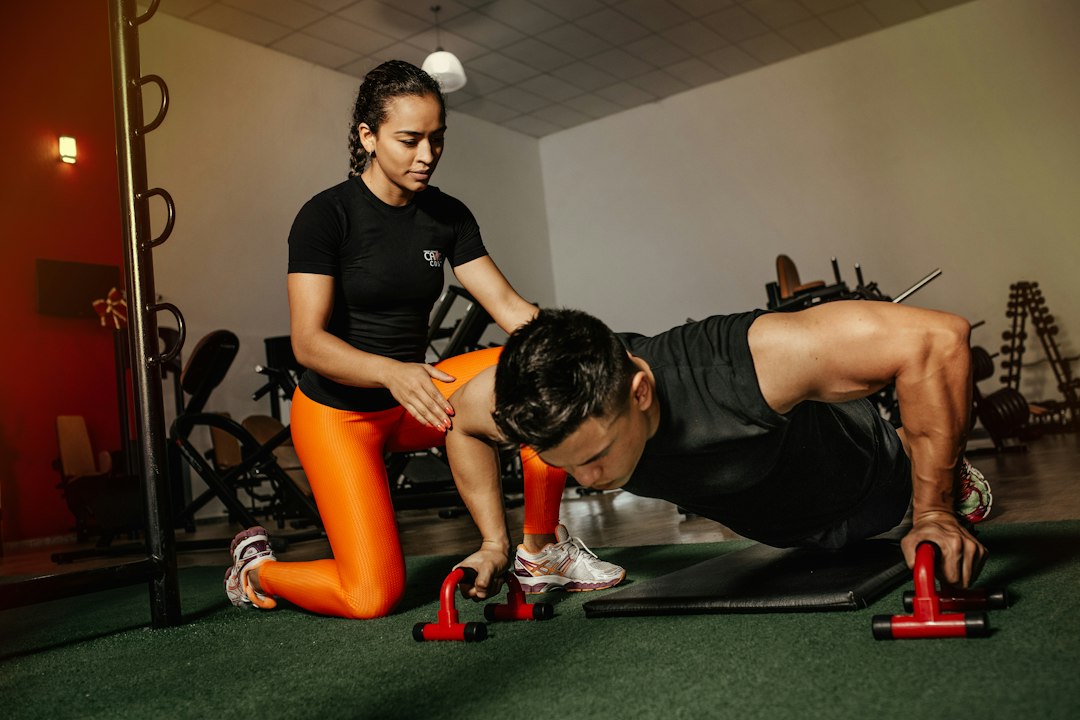
Functional Fitness After 55: Are Gains Real or Illusion?

You started functional fitness because it promised something gyms with machines never did: training that mirrors real life. Carrying, lifting, twisting, balancing. At 55 and beyond, that pitch is especially compelling. You're not training for a bodybuilding show. You're training to get off the floor without using your hands, to carry both grocery bags in one trip, to keep up on a hike without your knees buckling.
Six months in, you feel the difference. Balance is better. You can do a kettlebell swing without wincing. Getting up from a low couch doesn't require a plan. But here's the uncomfortable question nobody asks: is any of that translating into measurable muscle, or are you just getting better at the specific movements you practice, while the muscle tissue underneath stays exactly where it was?
This is the gap between feeling functional and being functional at a tissue level—and after 55, that gap matters more than almost any other fitness distinction.
**Why "Functional" Doesn't Automatically Mean "Muscle-Building"**
Functional fitness programs—kettlebells, bodyweight circuits, battle ropes, sandbag carries, agility ladders—are designed around movement patterns, not muscle overload. That's their strength for mobility and coordination. It's also their blind spot for hypertrophy.
Skill and coordination improve fast. Your nervous system gets efficient at a movement within weeks—recruiting the right muscles in the right sequence, reducing wasted effort, improving balance. That's a real adaptation. But it's a neurological one, not necessarily a muscular one. You can become dramatically better at a Turkish get-up without adding a single pound of lean tissue, because the improvement came from motor learning, not from muscle fibers growing.
This matters enormously after 55 because of a phenomenon called sarcopenia—the age-related loss of muscle mass that accelerates after 50 and can run silently alongside improved coordination. You can genuinely be getting better at the movements in your functional fitness class while your appendicular lean mass—the muscle in your arms and legs that determines whether you can carry your own suitcase at 75—continues to decline. Our piece on tracking sarcopenia risk before symptoms appear covers why this disconnect is so common and so dangerous: the symptoms show up only after a meaningful amount of muscle is already gone.
**What a DEXA Scan Actually Measures—And Why It Settles the Question**
If you're asking what does a DEXA scan measure, the short answer is: everything your functional fitness class can't tell you. A dual-energy X-ray absorptiometry scan separates your body into three precise components—fat mass, lean (muscle) mass, and bone mineral content—region by region, down to the individual limb.
That regional breakdown is the critical piece for anyone over 55 doing functional training. It shows your appendicular lean mass index (ALMI), the clinical marker used to screen for sarcopenia risk. It shows whether your left and right sides are building muscle symmetrically, which matters when so much functional work (single-arm carries, unilateral lunges) can mask imbalances that compensation patterns hide from view—a dynamic we break down in strength gains vs. muscle symmetry. And it shows visceral adipose tissue, the metabolically active fat around your organs that functional fitness alone often fails to touch, even when you're sweating through every class.
None of this shows up in how a workout feels. It shows up in the data.
**The Kalos Framework: Separating Skill From Tissue**
At Kalos, we think about every client's goals across three vertices: Aesthetics, Longevity, and Performance. Functional fitness after 55 sits squarely in the Longevity and Performance corners—but the metrics that actually define progress there (ALMI, visceral fat, bone mineral density, VO2 max) are rarely the ones a functional fitness class tracks. Classes track reps, rounds, and how a movement feels compared to last month.
We apply a bottom-up approach instead of a top-down one. The fitness industry tells you to pick a methodology—kettlebells, CrossFit, functional circuits—and hope it delivers. We're agnostic to the method. If your scan shows muscle mass climbing, visceral fat dropping, and bone density holding steady month over month, your functional fitness routine is working for you specifically. If those numbers are flat despite months of consistent training, something needs to change—more external load, more targeted resistance work, better recovery—regardless of how good the workouts feel.
This is also where the 80/16/3/1 principle for exercise applies directly. Consistency—showing up—is 80% of the outcome, and functional fitness classes are genuinely excellent at keeping people consistent because they're fun and social. But programming—progressive overload, sufficient resistance, enough volume per muscle group—is the next 16%, and it's where many functional programs fall short for muscle-building specifically. You can be perfectly consistent with a program that isn't progressively loading your muscles enough to counteract age-related decline.
**What Tends to Show Up on Scans**
Across the clients we scan who do primarily functional fitness after 50, a few patterns repeat. Grip strength and core stability markers—reflected in posture and balance—genuinely improve, often significantly. Cardiovascular capacity frequently improves too, especially in circuit-style formats with minimal rest. But lean mass gains are often modest unless the program incorporates heavier external loading (not just bodyweight or light kettlebells) with deliberate progressive overload. And visceral fat reduction tends to track with overall calorie balance and consistency far more than with the specific style of training—a pattern we've documented in clients across formats, from strength training three times weekly to pickleball-based activity.
We've also seen the inverse problem: clients who feel like their strength has returned after a layoff, only for a scan to reveal the muscle itself hasn't fully come back—a gap explored in strength returns after 50. Perceived strength and measured muscle mass are correlated, but they are not the same thing, and the older you get, the more that distinction costs you if ignored.
**If You're Searching "Body Composition Near Me"**
A lot of people searching body composition near me after 55 are trying to answer one question: is what I'm doing actually working? A scale won't tell you. A mirror won't tell you, especially once you're already fit enough that visible change slows down. A functional fitness instructor, however skilled, is evaluating your movement quality—not your muscle mass or visceral fat.
Kalos operates DEXA scanning locations across the Bay Area in San Francisco, Palo Alto, and San Jose (Pruneyard), and we've completed more than 3,000 scans for people asking exactly this question. The scan itself takes minutes and gives you a precise baseline across lean mass, fat mass, bone density, and regional distribution. From there, our NASM-certified performance analysts—many with elite athletic or data science backgrounds from places like Stanford, Harvard, and Equinox—translate those numbers into what to actually change: more load, different exercise selection, adjusted protein intake, or simply confirmation that your current functional fitness routine is doing exactly what it should.
That's the real value of combining functional training with objective measurement. Functional fitness workouts for over 50 can absolutely build real strength and real muscle—but only when the program includes enough resistance and progression to force adaptation, and only when you're checking the results against something more precise than how a workout feels. Everything we see across our client base, including the patterns in our review of body recomposition after 45, points to the same conclusion: effort and outcome diverge more often than people expect after midlife, and the only way to know which side of that divide you're on is to measure it.
Your functional fitness class may be exactly what your body needs. It may also need a few adjustments the mirror will never reveal. A scan tells you which one is true.

Ready to measure what matters?
Book your DEXA scan today and stop guessing about your health.